Civic Enterprise System Procurement
Service Design, UX Research, Workshop Facilitation, Product Strategy & Documentation
TL;DR
One of the nation's largest animal shelters relied on a legacy enterprise system to document, process, and manage its operations. However, the system was outdated and not user-friendly, contributing to productivity loss, staff burnout, data loss, and, indirectly, an overcrowding crisis and a potential loss of its no-kill status. After a City audit, it was determined the City would procure a new enterprise system. However, the shelter lacked the internal resources to define requirements for over 50 staff members across three shelter divisions.
Over 12 weeks, myself and a part-time service designer conducted user research, ran a participatory design workshop, and translated findings into a procurement-ready scope of work, including 14 personas, more than 200 user stories, and over 200 functional requirements. One year after implementation, euthanasia rates dropped by 25 percent, and leadership described the system as essential to their long-term strategy.
Goals
Primary Goal: Support the City of Austin in procuring a modern enterprise system for the City Animal Shelter that would support adoption, animal protection, and animal care & vet services.
Secondary Goal: To demonstrate the value user-centered design and research can provide civic services to IT leaders.
Problem
The agency does not have the bandwidth, resources, or product skills internally to conduct user research and write product documentation to procure a modern enterprise system. Without a modern enterprise system that supports staff, the shelter will continue to struggle with slowed down processes and burnout that will lead to the shelter losing their no-kill status as a shelter.
Constraints
The major constraints for this project included:
The procurement officer partner was not assigned until halfway through the initiative, requiring me to flag procurement-dependent decisions for when they joined and helping them onboard to the work being done.
Stakeholders were unfamiliar with human-centered design, requiring me to walk through examples for how and why HCD is valuable to documenting digital services.
The animal shelter staff and leadership were strained for time, requiring me to front-load harder-to-reach staff to provide flexibility while not extending the project timeline.
The culture of the shelter was fragile due to the public news of their collective performance.
Approach
Based on my experience with large modernization efforts and creating vendor proposals, I decided to run this research as building blocks towards a product strategy that provided a 360 view of the users and what they needed from the system. This meant conducting research for what the collective staff needed, with a strong focus on how people do their work. Their workflows, the language and data they use, required features, and the systems they need to integrate with.
Ecosystem map for the Austin Animal Center
In the first week, I met with stakeholders to learn about the project and run an ecosystem activity with shelter leadership to visualize our users and stakeholders. This led to segmenting the 50+ staff into 3 role categories: animal care & vet services, shelter operations, and animal protection.
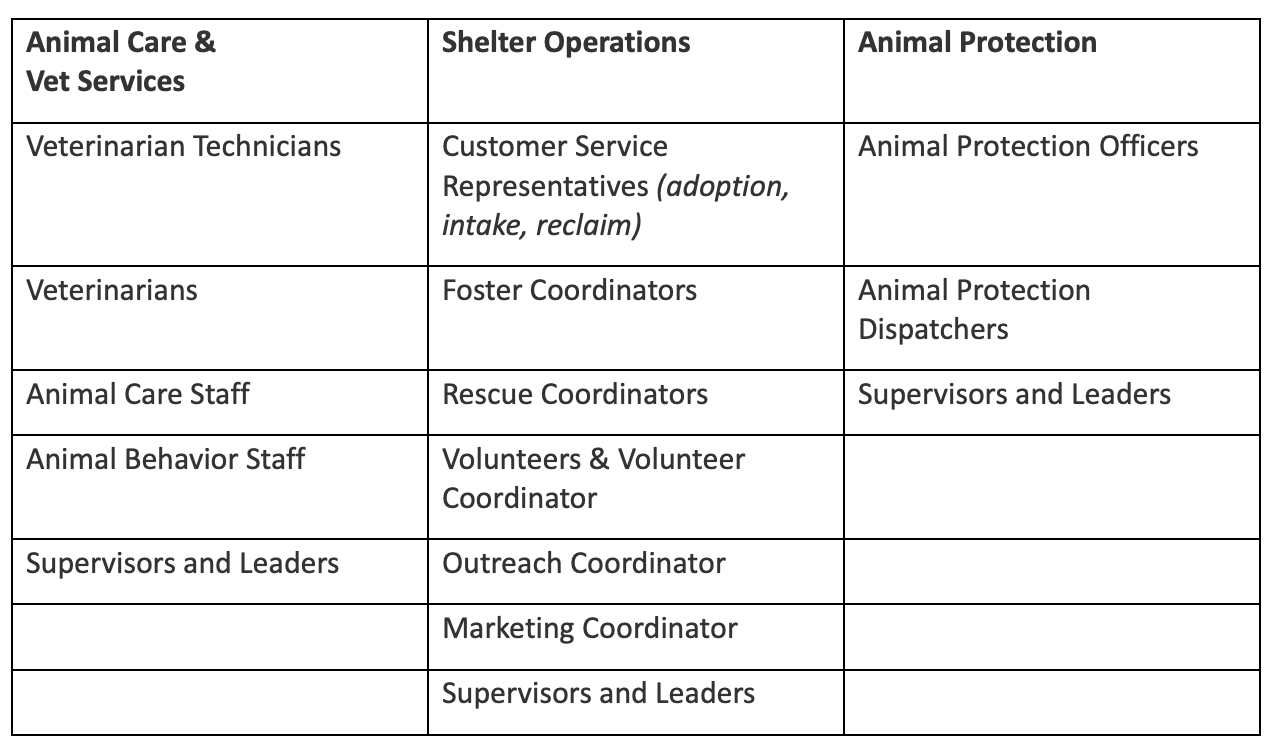
Austin Animal Center Divisions and Roles to research: 3 divisions and 15 roles
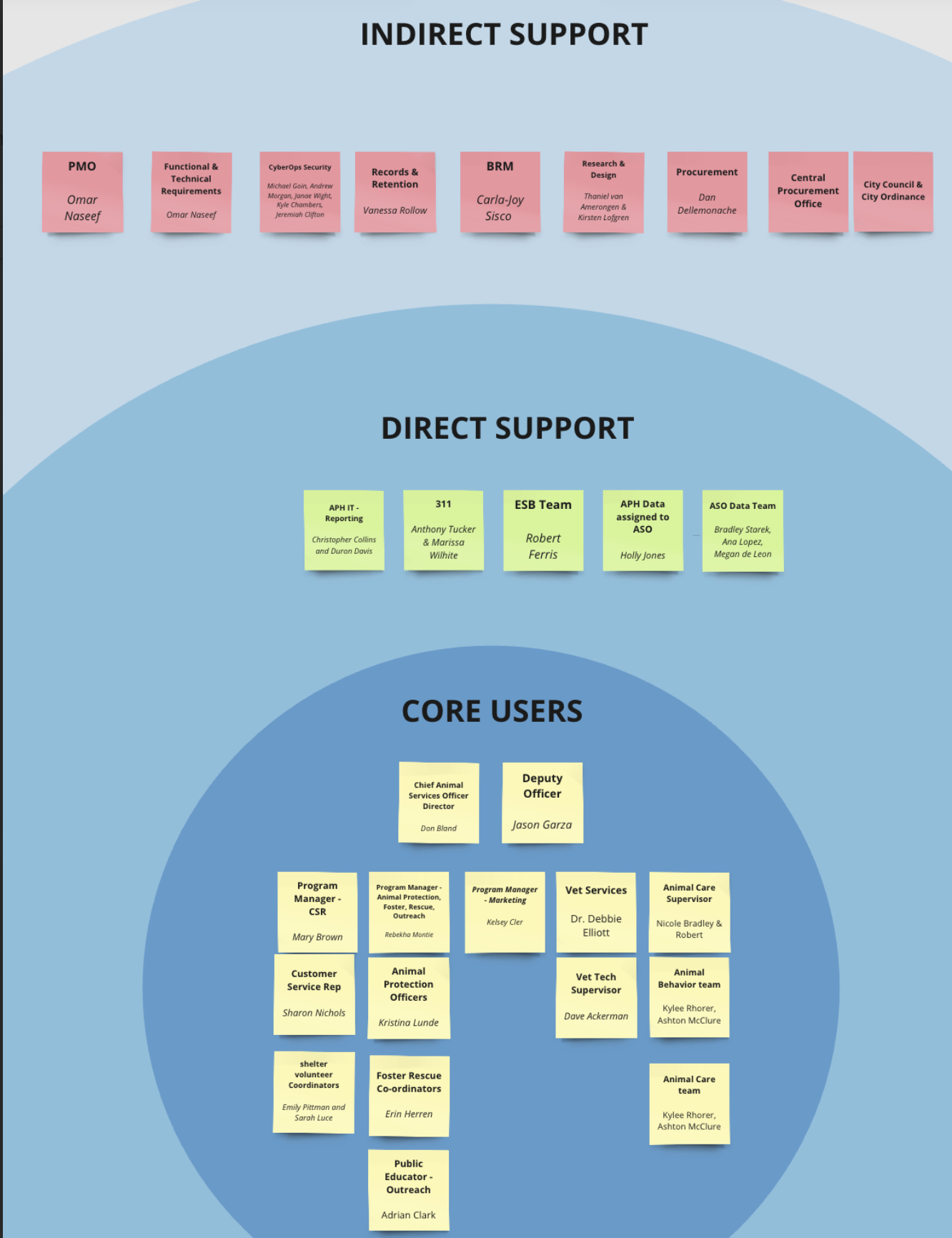
Ecosystem mapping activity using Miro with shelter leadership
Research Plan & Strategy
Using the information gathered from the first week, I created a draft research plan using a research canvas template. I then shared it with the shelter leadership to update it based on their inputs, questions, and insights. Afterwards, I developed a formal research plan for the project.
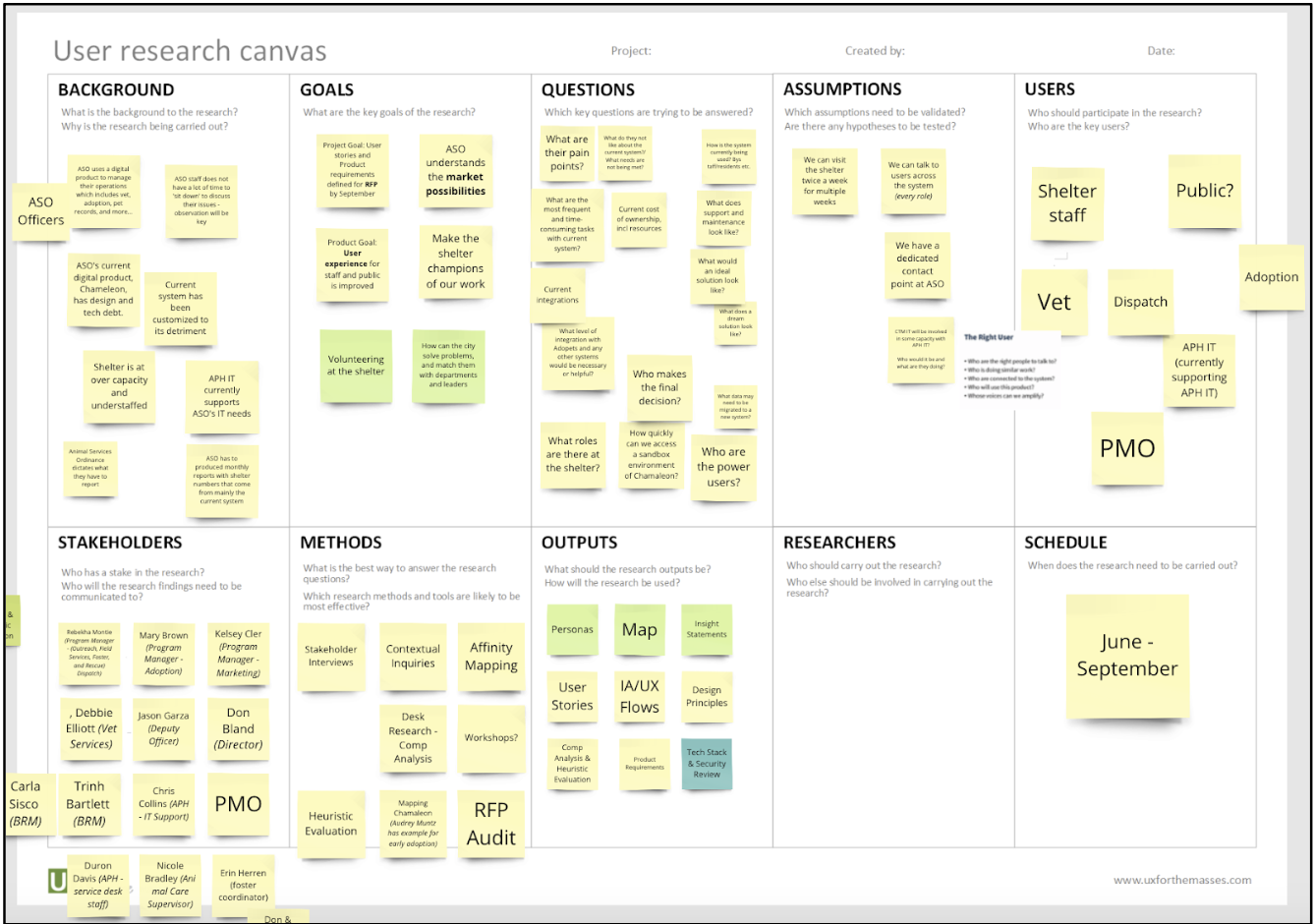
Co-created research plan using research canvas
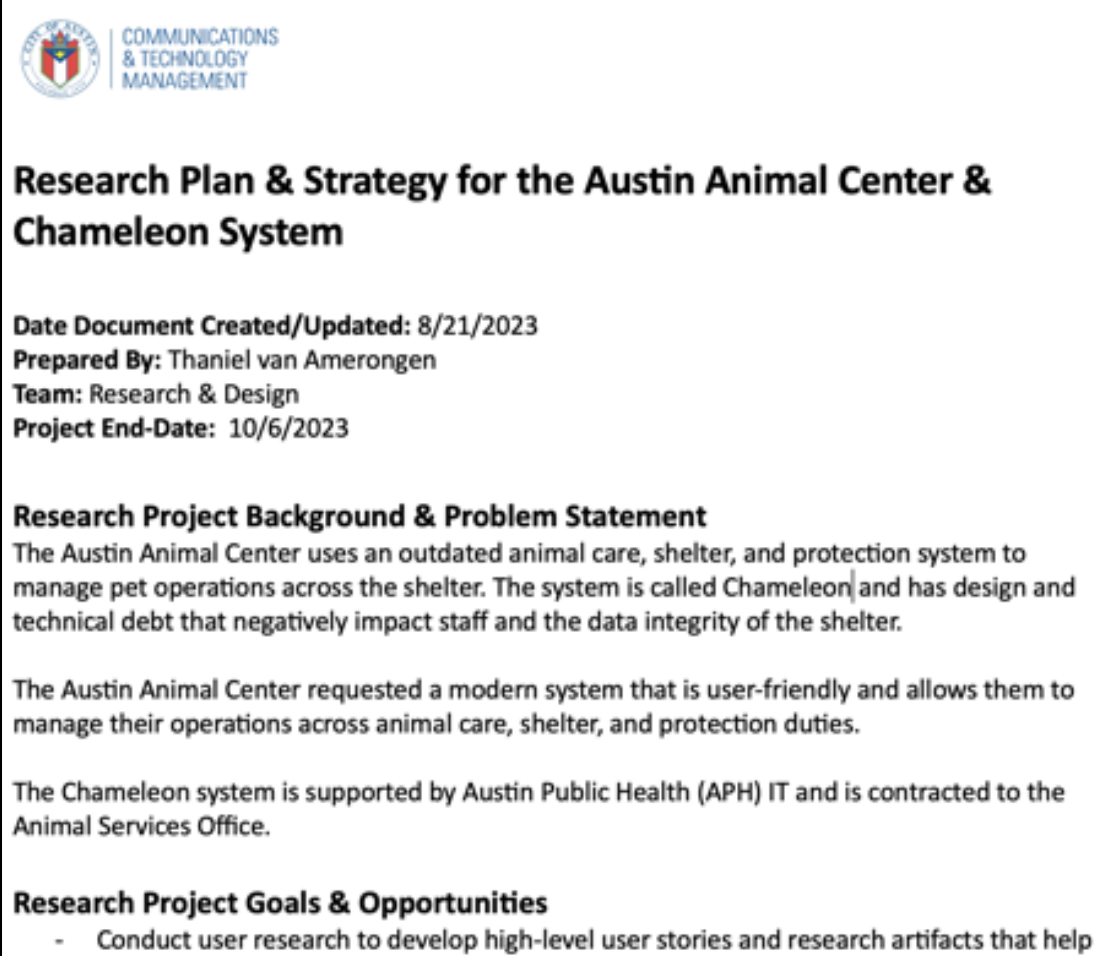
Official research plan based on the co-created research plan
Contextual Inquiries & Research Artifacts
Over the next 8 weeks, I conducted contextual inquiries with each role and developed research artifacts to build a product strategy. I started by developing personas and journey maps to better understand the distinct user types. Once the personas and journeys were ready, I began developing the user stories, features list, insight statements, and an information architecture. Combined, these artifacts informed the Scope of Work.
In total, I developed 14 personas, 17 journey maps, features list, 200+ user stories, and 2 key information architecture categories: pet profiles and adopter profiles.
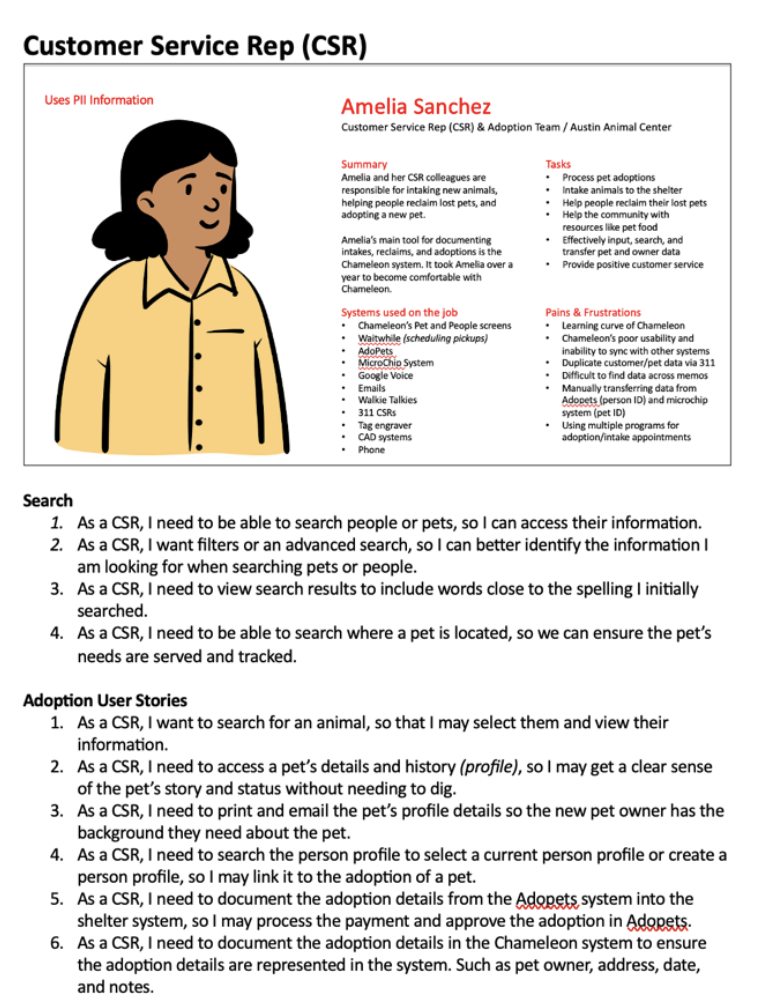
Personas with user stories categorized by task
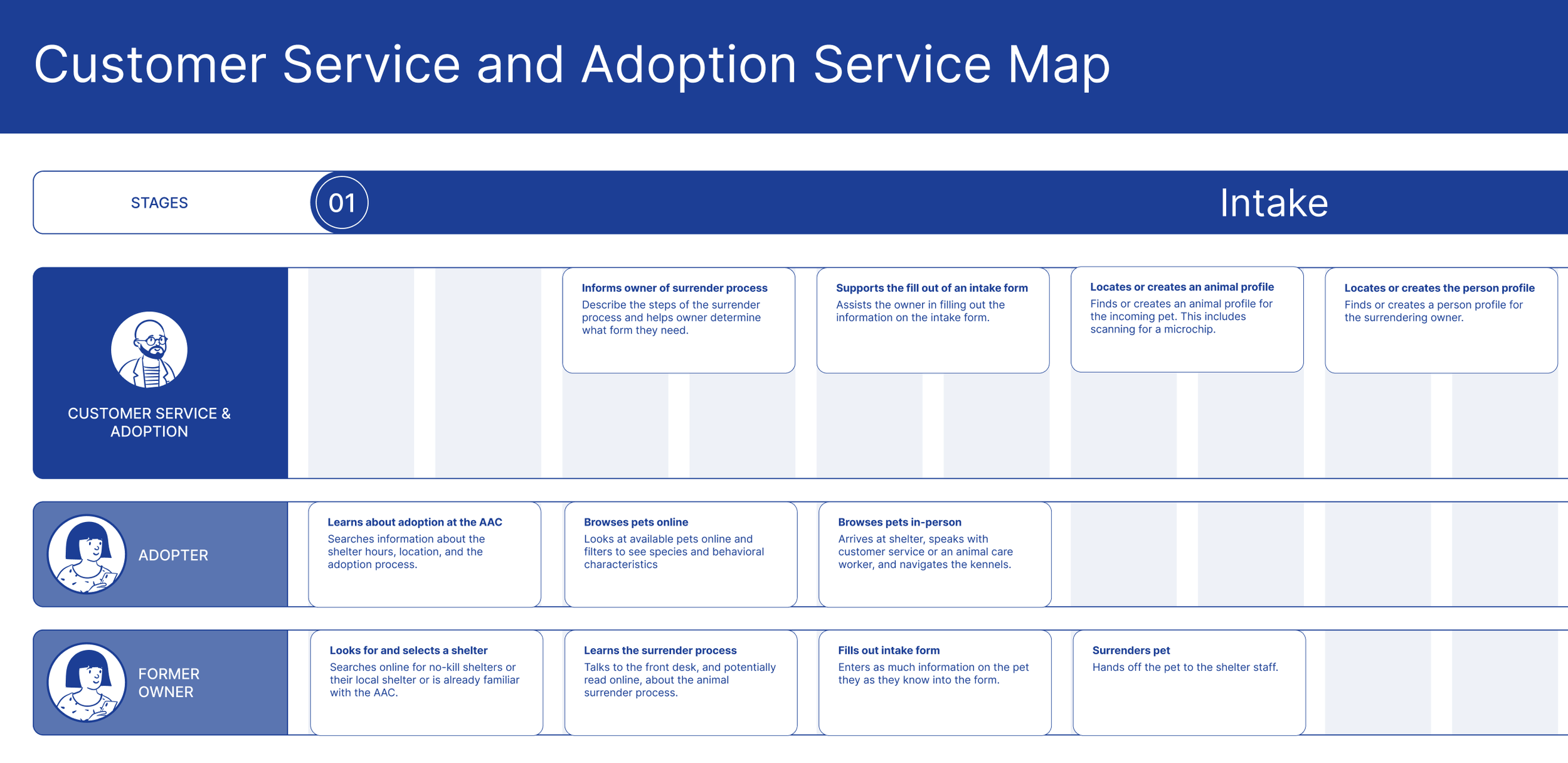
Journey map for adopting a pet
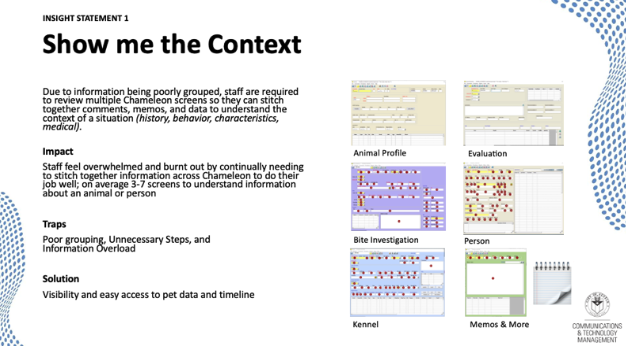
Insight Statements
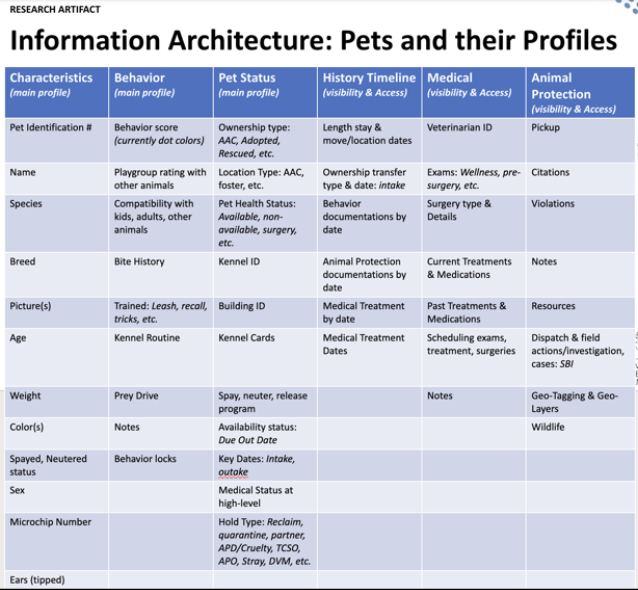
Information Architecture for Pet Profiles
Partcipatory Design Workshop
Myself and the part-time service designer ran a half-day workshop to share our learnings and validate our key artifacts before writing the functional requirements and scope of work.
The workshop included key stakeholders across the shelter, IT, and procurement teams. In total, we had 25+ workshop participants.
The benefits of the workshop were that it built consensus, reduced the turnaround time, and finalized the material needed for the final stages of the scope of work.
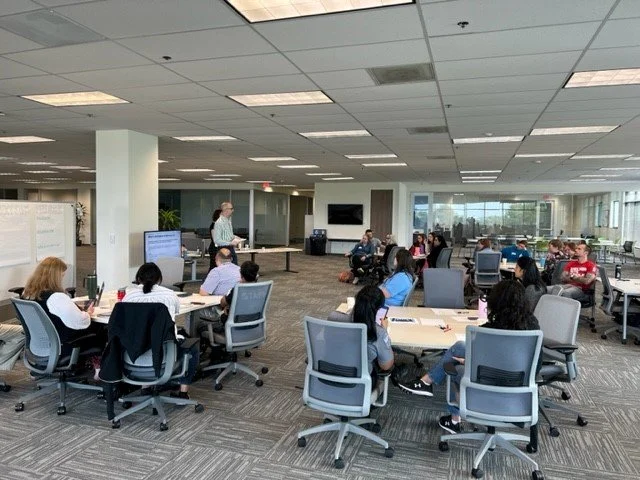
Presenting a workshop activity at the IT office
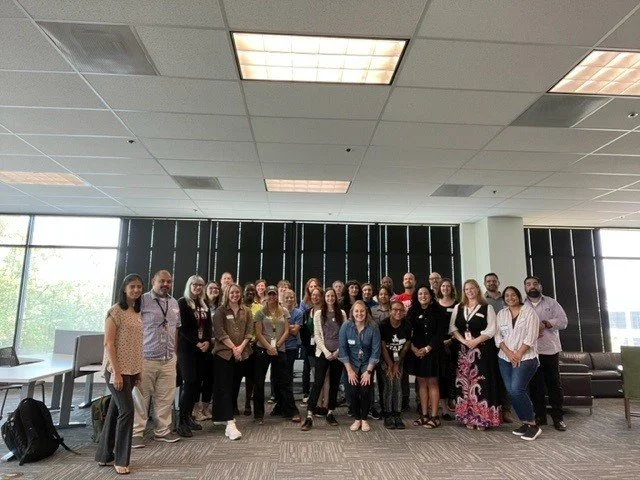
Workshop picture with shelter, IT, and procurement staff
Functional Requirements and Final Report for the RFP Scope of Work
The workshop outputs were used to develop 200+ functional requirements, the evaluation criteria that embedded usability, and the Request for Proposal (RFP) solicitation.
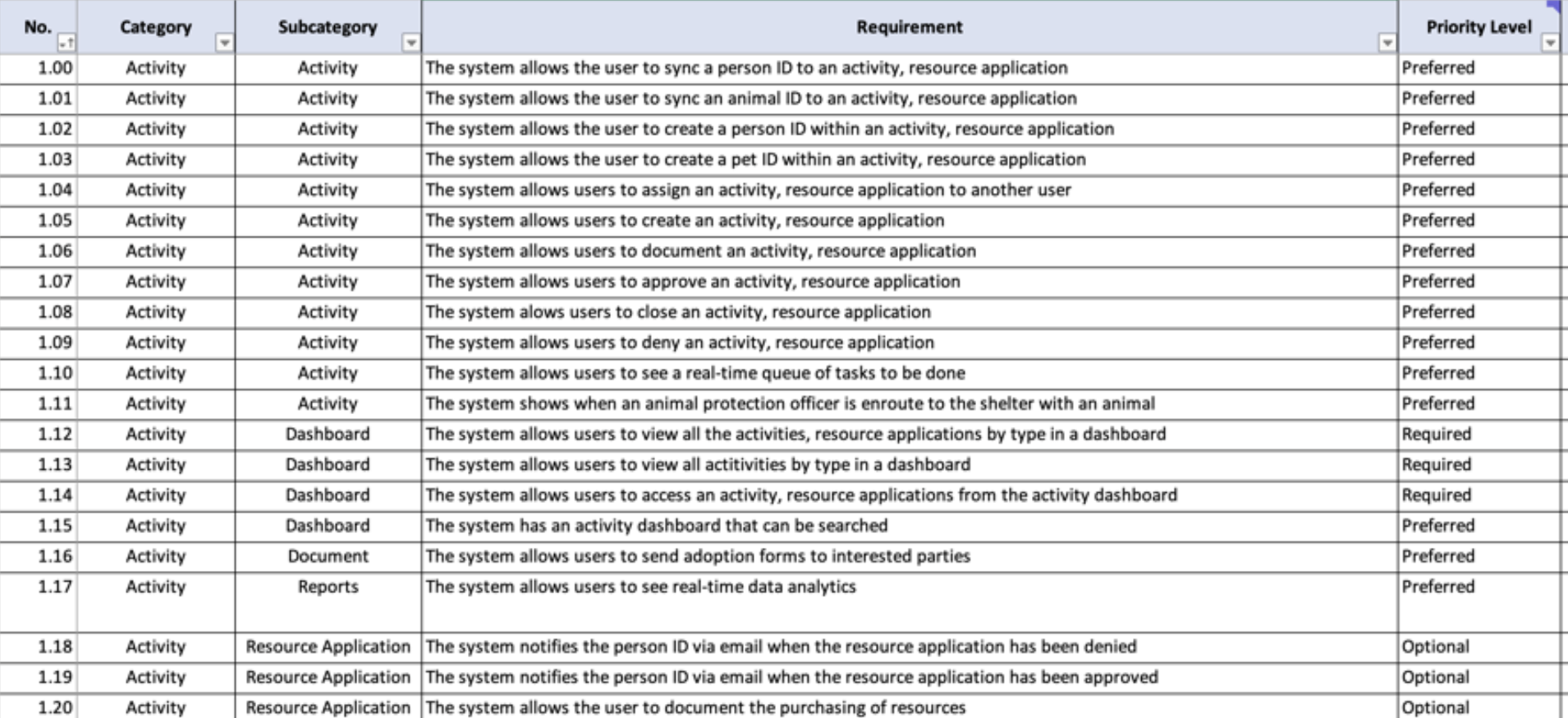
Sample of functional requirements
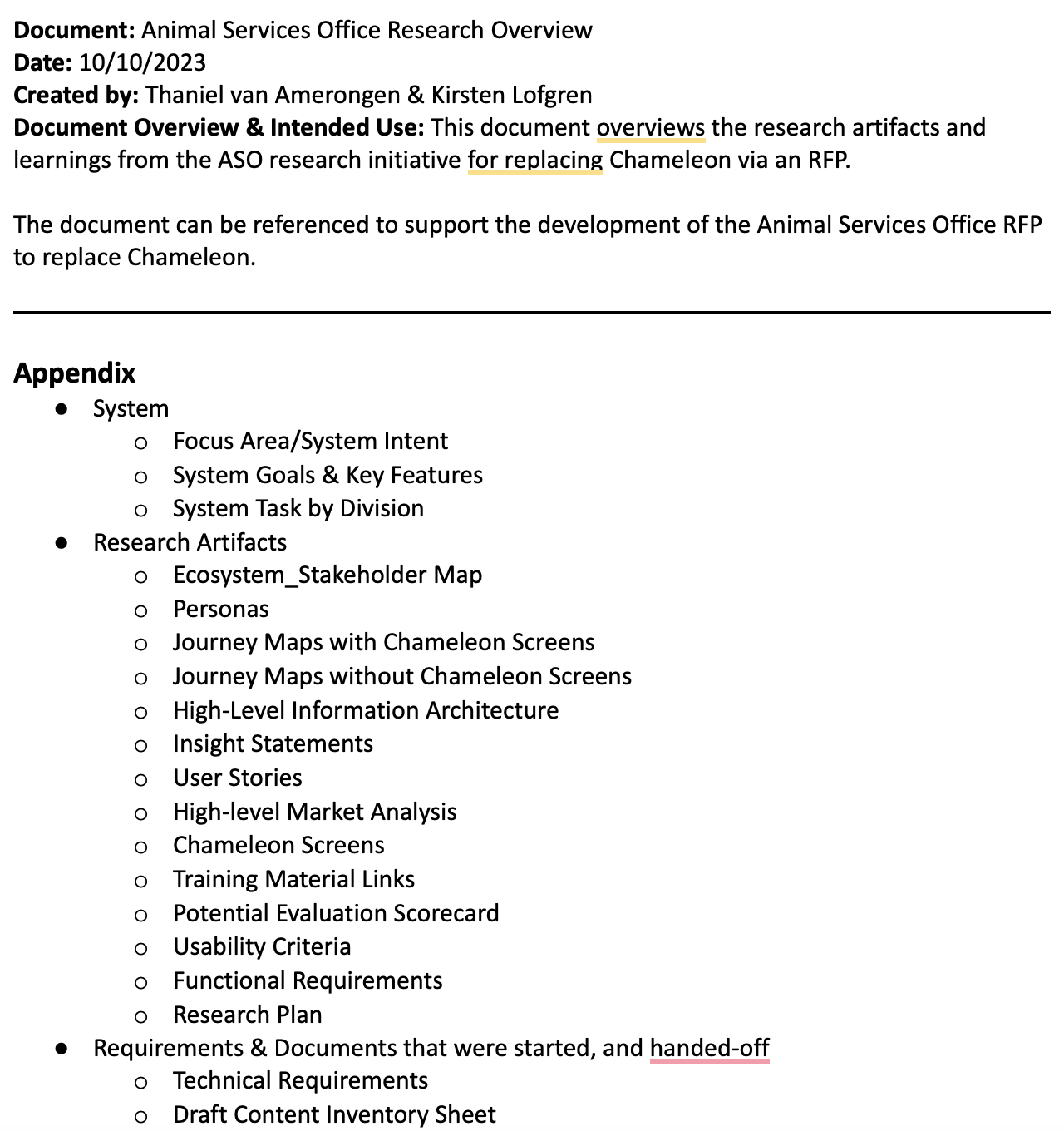
Final report with all research documents
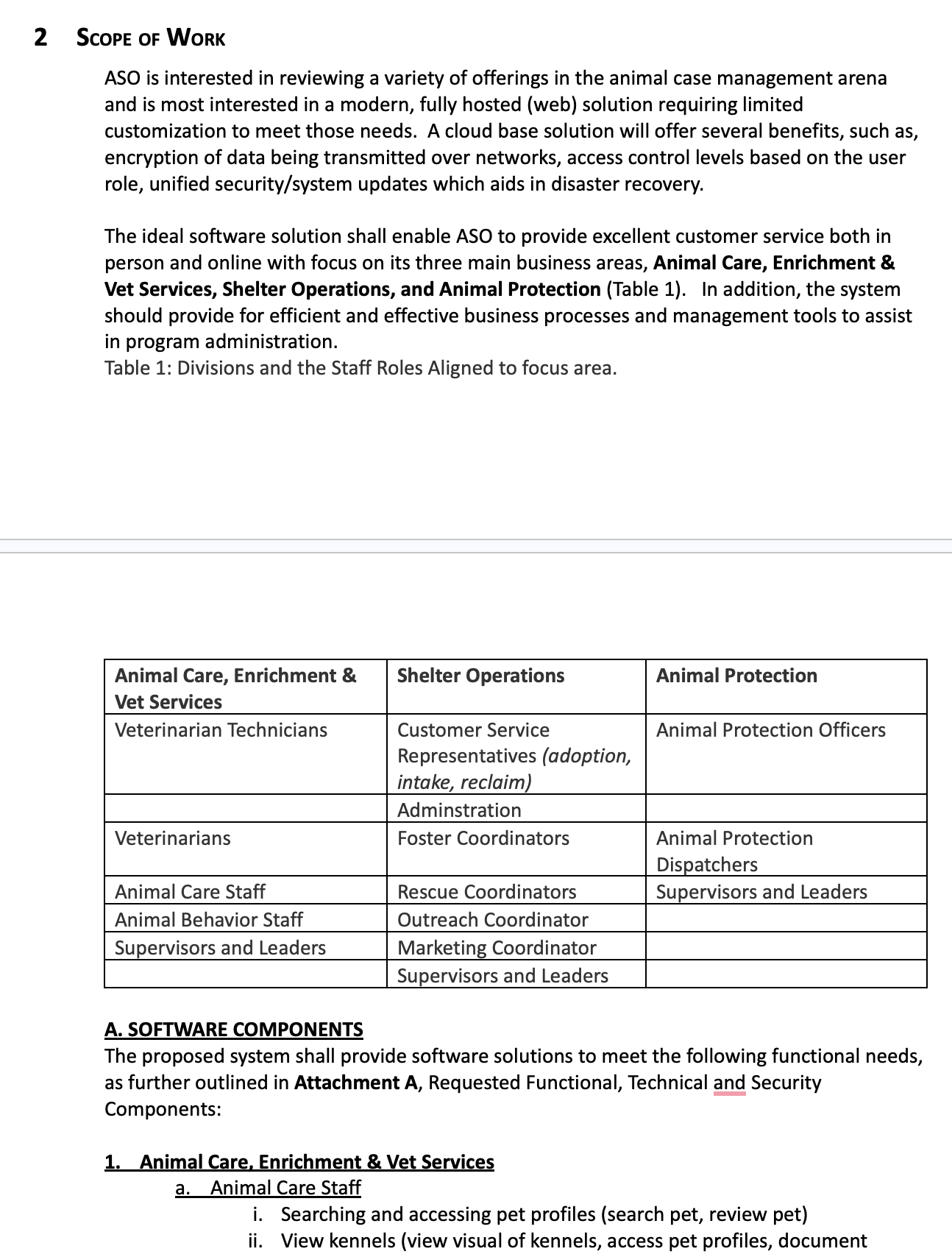
RFP Scope of Work and Evaluation Criteria
Outcomes
The RFP was published on time, and in 2024, the new shelter system was implemented. In addition, the vendor used the research to improve their system, specifically the information architecture and workflows.
The new system enabled shelter staff to access, update, and add data more easily. These efficiency gains addressed core operational issues. One year after implementation, euthanasia rates, a key indicator for no-kill shelters, decreased by 25%.
In 2025, the interim Chief Animal Services Officer stated:
"This system is a critical investment in our future. By improving how we manage data across all shelter operations—from intake and adoption to foster and volunteer coordination—we’re supporting the priorities laid out in our new Strategic Plan, including greater transparency, enhanced public access to information, and a more efficient service model for Austin’s residents and animals."


Building on the Foundation
As the research concluded I suggested a few recommendations to support the team moving forward. They include:
Leveraging the draft content inventory to organize, structure, and label data for data migration efforts. The Austin Shelter Office and Austin Public Health data team continued this work to support the transition.
To work with me and the Digital Services team when vendors were being selected to run a usability test to measaure how user-friendly the vendor solutions were. I was involved in the vendor evaluation process.
If needed, to contact me and the Digital Services team to support revising processes if needed. I consulted the team, but because the vendor leveraged the research to update their Information Architecture and workflows, the new system did not require revising processes.
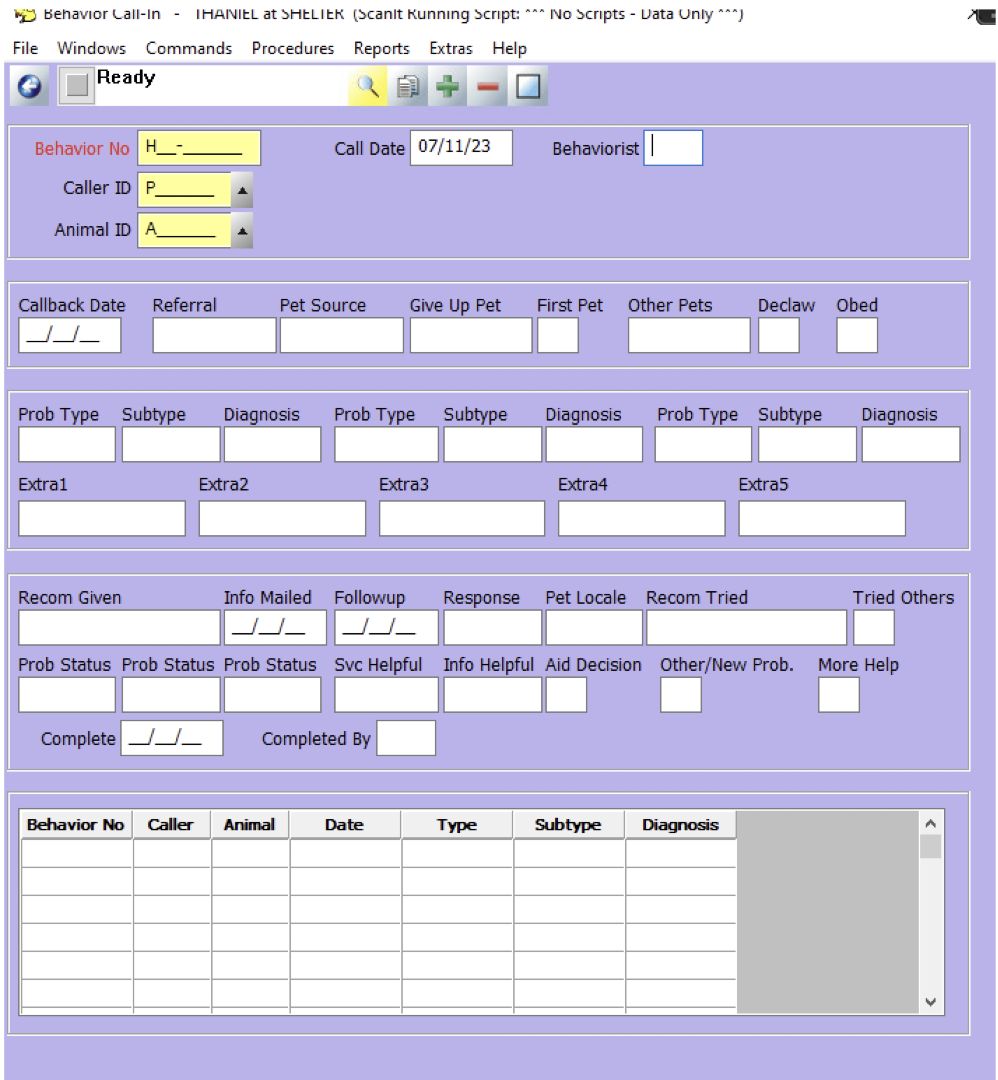
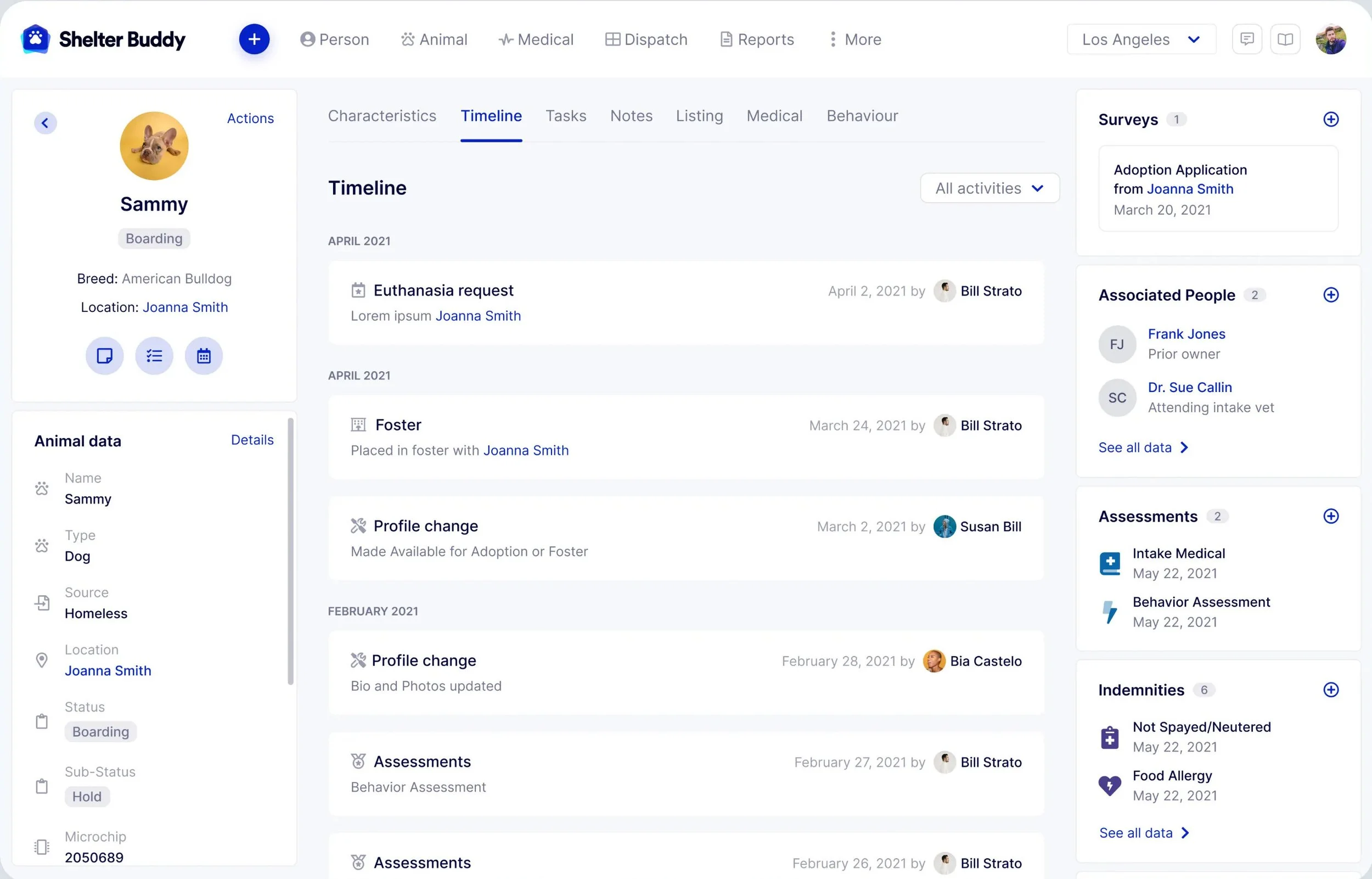
Learnings
A few of the learnings I had on this project include:
Participatory Design helps align stakeholders. The discovery workshop accelerated the development of the functional requirements from 1 month to 1 week.

Scheduled communication provides visibility to key stakeholders. By running weekly standups with shelter leadership, we built rapport and trust that made it easier to overcome roadblocks and obstacles.

City staff were open to change. This project incorporated research methods and artifacts new to City staff. Leading to IT leadership asking for human-centered design to be applied in new areas like the NIST cybersecurity framework.